
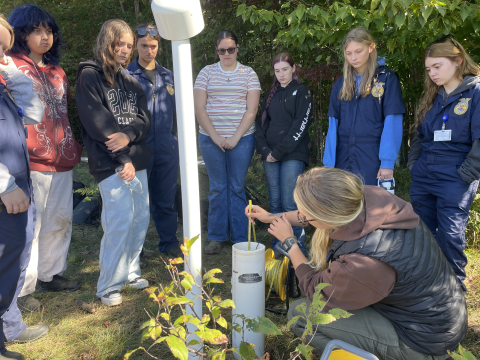
KALKASKA COUNTY, Mich. — What happens when high school students leave the classroom and step onto a working Michigan potato farm with water-monitoring equipment in hand?
They begin to see agriculture — and the responsibility that comes with it — from a very different perspective.
Agriscience students and Future Farmers of America (FFA) students from Northwest Education Services (North Ed) Career Tech and Ellsworth Community Schools recently spent time at Iott Seed Farms in Kalkaska County conducting hands-on environmental research alongside Midwest Water Stewards. The multi-day experience gave students the opportunity to study groundwater and surface water interactions, evaluate soil and water conditions, and see firsthand the steps farmers take to protect the natural resources that make agriculture possible.
The program was sponsored by the Michigan Potato Industry Commission (MPIC) and Potato Growers of Michigan, Inc. (PGMI) as part of the industry’s commitment to educating students about modern agriculture, environmental stewardship, and the many career opportunities available across the agricultural industry.
For Michigan potato growers, the goal went well beyond teaching students how to collect a water sample or measure stream flow.
It was about helping students understand agriculture well enough to become informed voices for it — wherever their careers may take them.
A Grower Who Opens the Farm Gate
A key part of making the program possible has been Dennis Iott, owner of Iott Seed Farm and president of PGMI.
For the past six years, Iott has welcomed the students and Midwest Water Stewards to his farm, providing them with access to a working agricultural operation where they can see firsthand how farming and natural-resource stewardship intersect.
Iott believes strongly in giving students the opportunity to experience agriculture beyond the classroom and understands the importance of allowing young people to ask questions, gather information and see farming practices for themselves.
“Farmers have a responsibility to protect the resources we depend on, but we also have a responsibility to help people understand what we are doing,” Iott said. “If we want people to understand agriculture, we have to give them the opportunity to come see it for themselves.”
His commitment to hosting the program is an example of the grower-led approach that the potato industry believes is essential to agricultural education and advocacy.
“This program is special because Dennis has continued to open his farm to these students year after year,” Turner said. “He understands that this isn't just about one field day. It's about building relationships and giving students an honest look at modern agriculture. That kind of firsthand experience can stay with someone for a very long time.”
Bringing Students onto the Farm
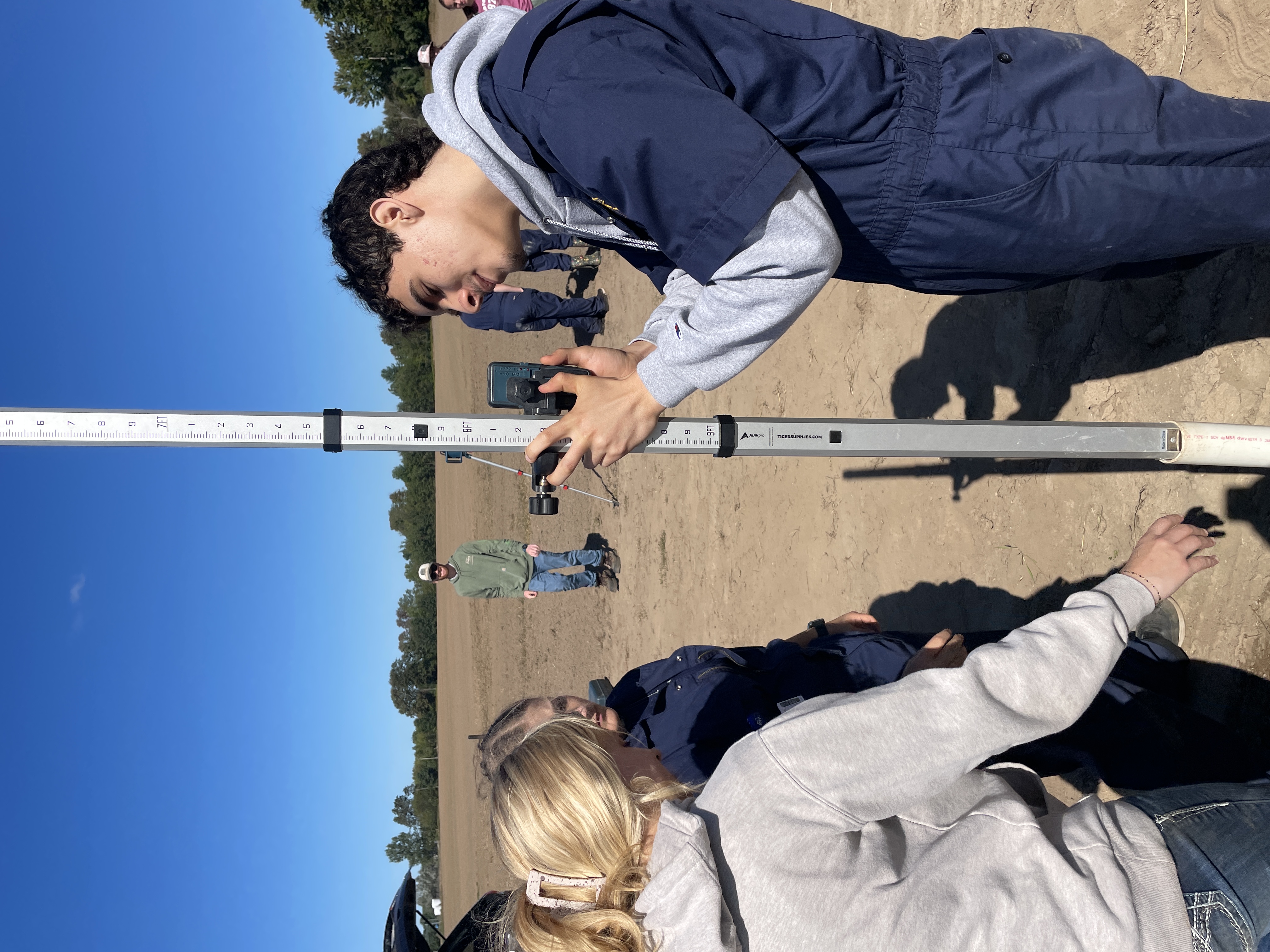 Agriculture is often discussed by people who have never stood in a field, tested a monitoring well, evaluated a stream, or talked with a farmer about the decisions that go into managing water and soil.
MPIC and PGMI believe that needs to change.
“Farmers have a responsibility to protect the resources we depend on, and we also have a responsibility to help the next generation understand what that stewardship actually looks like,” said Dr. Kelly Turner, executive director of the Michigan Potato Industry Commission “You can't fully understand modern agriculture from a textbook or a social media post. We wanted these students to come onto a farm, ask questions, collect data and see the science and stewardship happening for themselves.”
During the field study, students worked with Midwest Water Stewards to collect data from monitoring wells and nearby surface water. They measured stream conditions and water velocity and learned how information gathered in the field can be used to understand the relationship between agricultural land, groundwater and surface water.
More importantly, however, they were learning how to ask questions and evaluate evidence.
That is exactly the kind of learning MPIC and PGMI hoped the program would provide.
Science, Stewardship, and Critical Thinking
Todd Feenstra, executive director of Midwest Water Stewards, challenged students to move beyond simply accepting what they hear and instead develop their own understanding through observation and data.
The approach aligns closely with MPIC and PGMI's philosophy about agricultural advocacy.
Agriculture needs people who can have informed conversations about water, soil, food production and environmental stewardship — even if they never become farmers.
“Whether these students become farmers, scientists, engineers, teachers, policymakers, business owners or something we haven't even thought of yet, they are going to have an opportunity to influence how people understand agriculture,” Turner said. “We want them to have enough firsthand knowledge to ask good questions, look at the data and understand that farmers care deeply about the resources they depend on.”
That kind of critical thinking is becoming increasingly important.
Michigan agriculture operates at the intersection of food production, environmental stewardship, economics, technology, public policy and increasingly complex natural-resource questions. The people who will make decisions about those issues in the future may not all come from farms.
MPIC and PGMI want them to understand the farm before they make those decisions.
More Than One Path into Agriculture
The experience also exposed students to something else MPIC and PGMI considers important: agriculture is much bigger than farming.
A student interested in environmental science might find a career in water management. Another might pursue agronomy, engineering, research, conservation, communications, business, food processing, technology or public policy.
For student Octavio Serrano, the experience reinforced his interest in environmental science.
“I plan on going to college for environmental science,” Serrano said. “I feel like this could be something that I see myself doing in the future.”
That is an important outcome for MPIC and PGMI.
Michigan's agricultural industry will need talented people in thousands of different roles in the decades ahead. Some will grow potatoes. Others will develop new varieties, analyze water data, design irrigation systems, conduct research, work in food processing, develop technology, communicate with consumers or help shape agricultural policy.
All of those people are part of agriculture's future.
Starting an Advocacy Journey
MPIC and PGMI also see programs like this as an opportunity to begin developing agricultural advocates.
That does not mean every student needs to become a spokesperson for farming or choose an agricultural career.
It means students should leave the farm with a more complete understanding of where their food comes from, what farmers do to protect natural resources and how complicated the decisions involved in modern food production can be.
A student who eventually becomes an environmental scientist may remember what they learned standing in a Michigan potato field.
A future teacher may take that experience into a classroom.
A future engineer may design systems that help farms use water more efficiently.
A future policymaker may approach an agricultural issue differently because they once had the opportunity to collect the data themselves.
And some students may discover that agriculture is where they belong.
That is the long-term investment MPIC and PGMI hope to make.
“We don't know where these students will be ten, twenty or thirty years from now,” Turner said. “But we do know they will be part of our communities, our workforce and our society. We want them to have a firsthand understanding of agriculture, and the work farmers are doing to protect our resources. If we can help them become informed, thoughtful advocates for agriculture — regardless of the career they ultimately choose — that is a tremendous investment in our industry's future.”
Growers Investing in the Future
Michigan potato growers understand that protecting water and soil is not simply an environmental objective. It is an agricultural necessity.
Farmers need healthy soil, reliable water and functioning ecosystems to produce food year after year.
But stewardship also requires communication.
The agricultural community cannot assume that people understand what happens on a farm simply because agriculture surrounds them.
Sometimes the best way to build understanding is to open the gate and invite students in.
At Iott Seed Farms, students weren't simply told that farmers care about water.
They were given the opportunity to see it, measure it and ask questions about it themselves.
That is the kind of experience MPIC and PGMI believe can make a lasting difference.
Michigan potato growers are not only growing potatoes. Through programs like this, they are helping grow the next generation of scientists, professionals, community leaders and agricultural advocates who will help shape the future of Michigan agriculture.
And that may ultimately be the most important crop of all.