
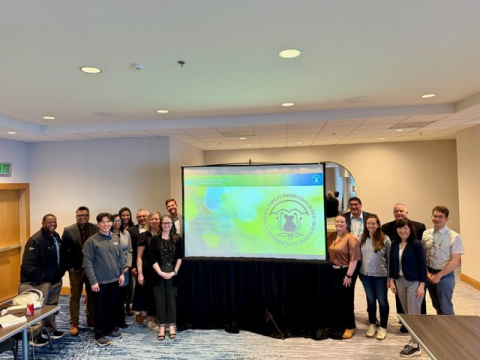
After a series of logistical challenges in recent years, the USDA’s Plant Variety Protection Board was able to meet in-person recently for the first time since 2020. The meeting took place in San Diego on Feb. 16-17, 2026.
The 14-person board exists to advise the USDA on issues related to the Plant Variety Protection Act, which provides legal protection in the form of intellectual property rights to developers of new plant varieties. The act is administered by the USDA’s Plant Variety Protection Office.
Representing the potato industry on the board is Melissa Boersema, Chief of Operations at Sklarczyk Seed Farm in Johannesburg, Michigan. Boersema provided feedback on her experience at the meeting to the Michigan Potato Industry Commission (MPIC). (Pictured: The PVPB, with Boersema standing on the right side of the screen.)
Q: What was covered at the meeting?
Boersema: Some of the key discussion topics of the meeting included staffing challenges of the PVP Office due to the federal hiring freeze, engagement strategy with industry partners, the emergence of vegetative PVP and how it relates to germplasm deposit requirements, term of protection for potatoes, and demonstrating the integrity of breeder-conducted trials to international stakeholders.
Q: Any developments or decisions?
Boersema: Due to the length of time that it takes to develop and commercialize potato varieties, specifically, there have been inquiries toward extending protections for potatoes beyond the typical 20-year term. Canada has proposed a 25-year term of protection for potato varieties, and the European system has a term of 25-30 years. The discussion amongst all of us on the board concerned the balance between driving innovation and supporting the public interest in the case of newly developed potato traits. Ultimately, it was the decision of the board not to recommend revisiting the act establishing PVP, which would be a necessary step if the term of protection is to be changed.
Q: What did you take away from the experience? If someone was interested or on the fence about getting more involved in something like this, any advice for them?
Boersema: Going into serving on the board I was unsure of how much insight or value I could provide to the highly qualified group of professionals, and hesitant to commit to the time away from my family and the greenhouse team. However, I was surprised to find how unique my perspective and contributions to the board were as a young(ish) woman working for a family farm. As the only active participant in the potato industry on the board, I was able to offer valuable insights concerning the challenges potato farmers face every day and how developments in breeding can have a profound impact on the industry. It has been my experience, time and time again, that the greatest opportunities to have an impact are in situations where we can be at our most uncomfortable. You have to be present and speak up if you want to make an impact, or risk losing the opportunity to use your voice. Serving on a board, sharing your story with government officials, and advocating for the needs of our peers are all great ways we can help to fuel change for the better.
Melissa Boersema is currently serving a two-year term on the Plant Variety Protection Board. It started in December 2024.